
Six of Wands
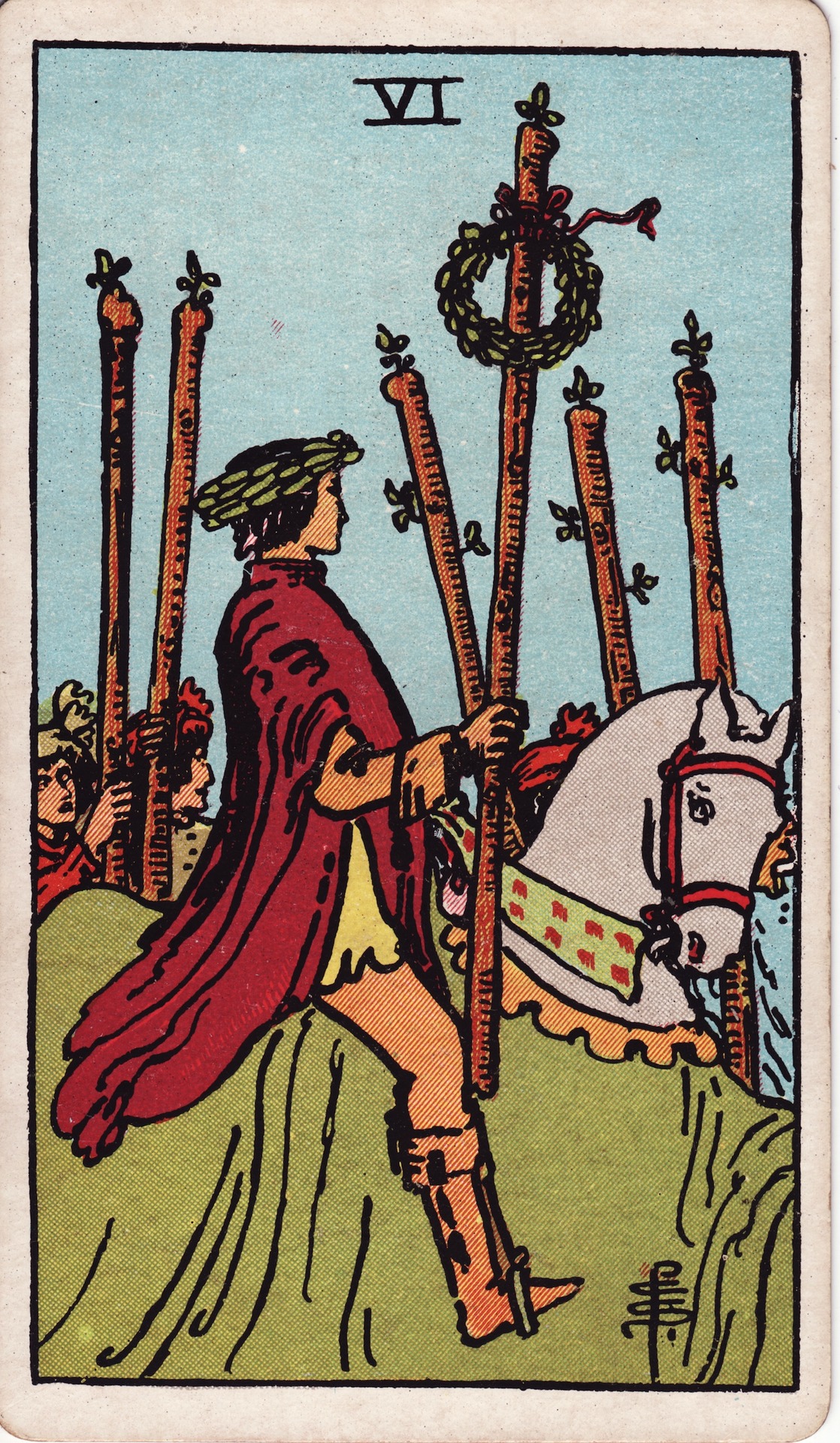
AKA Lord of Victory
In the pomp of deep night and high glory of day,
Where the long golden prospects stretch shining away.
With pennons and banners the pageants pass by,
And the crash of their music goes up to the sky.
– Arthur Waite, Collected Poems
Iconography
- red robe: ambition [1]
- green robe: profit and commercial gain [1]
- yellow undergarments: personal contentment [1]
- laurel wreaths: victory [1]
Meaning
Wen, Benebell. Holistic Tarot: An Integrative Approach to Using Tarot for Personal Growth.
The Six of Wands is the card of victory. Good news is coming to the Seeker. There will be advancement and progress in work or career, or artistic or scientific advancement due to one’s leading innovation. The card is also about the Seeker leading others to victory. A creative project yields commercial fruition. The red robe that the man wears indicates ambition; the green robe on the horse indicates profit and commercial gain; yellow undergarments peeking out from beneath the red robe indicate personal contentment. Note that laurel wreaths throughout the Minor Arcana represent victory. However, the remaining questions to ask are: How does the Seeker feel about the victory? Does the validation bring fulfillment? What exactly has been won here, a battle or the war? While the Seeker has enjoyed victory to a certain extent, the end message of the card suggests that there are still “miles to go” before the Seeker may sleep. [Robert Frost’s “Stopping by Woods on a Snowy Evening is cited.”] There is more glory ahead in the Seeker’s potential. This is not the end of the Seeker’s accomplishments. The Six of Wands indicates victory, but not necessarily a sense of satisfaction.
Reversed Meaning
A positive omen, in reverse the Six of Wands means essentially the same as it would upright. However, there may be delays and challenges in the Seeker’s way that need to be overcome. In reverse, the forecast of victory is still strong, but it may take longer than the Seeker expects or there may be minor hiccups. The card could also indicate strong untapped potential in the Seeker for advancement in creative or innovative fields, particularly as a profession or career. If the Six of Wands appears in reverse for a young Seeker, it could suggest the future potential to advance significantly in career aspirations, creativity, or innovation. The card could indicate advancement in the Seeker’s studies, or the materialization of tangible financial gain or reputation in the Seeker’s professional field, after attaining a high level of education. Again, like the card upright, there may be victory to be had, but not necessarily a sense of fulfillment or satisfaction.
Graham, Sasha. Llewellyn’s Complete Book of the Rider-Waite-Smith Tarot: A Journey Through the History, Meaning, and Use of the World’s Most Famous Deck.
When the Six of Wands appears, it lets you know you have something to celebrate. A figure carries a staff and rides his horse in a celebratory parade. The crowd waves five wands into the air. Victory parades evoke national, team, and individual success and jubilation. Sporting events culminate in victory marches for winning teams in their respective cities. Fire is the vital essence used in celebration the world over. The Six of Wands reflects the image of a victory march. Success is yours. Mission accomplished. Onward movement commences.
Waite tells us “footmen with staves are at his side.” The figures marching forward in victory are part of a processional, yet a crowd is nowhere to be seen. Is the victory real or imagined? The card stands as a reminder of the people who surround you and support you. No success is obtained alone. You are supported every step of the way, whether or not you realize it.
It is the card of achievement, but as in all minor arcana six cards, the story is far from complete; there is more to come. Waite’s article “The Tarot: A Wheel of Fortune” describes this card as “crowned with hope and confidence.” Having, maintaining, and exhuming hope and confidence can be seen as a victory in itself. The card issues forth the magnanimous feeling that helps us obtain any goal. It fills us with energy. It is a card of inspiration regardless if you are reflected by the figure on the horse or if you stand in the crowd. Deep down, you discover anything is possible.
Waite admits the card has many meanings. He offers a surface reading describing happy news and hope. He neglects to mention the deeper esoteric meaning of the number six, which corresponds to the heart center of the Tree of Life. As such, this is the space of compassion, kindness, and infinite love.
Pamela clearly illustrates the esoteric title, “Lord of Victory.” The horse in her card eerily matches the posture of the horse in the Knight of Cups of the Sola Busca deck, where the horse cards conveys a message of its own with his turned head. It is as if the horse senses or sees something the rest of us do not. Indeed, as cards numbered five bear challenge, six cards usher respite and success. Sixes bear reward for experience and through the challenging times reflected in previous cards. It also reminds you it is only through experience that we discover what we are made of. No victory exists for things arriving easily or automatically. Waite’s card follows the Book T’s seamless description of “victory after strife.”
Sixes in the minor arcana each imply separation and hierarchies between people. One figure towers over the rest. It suggests issues of separation, authority, and positions of power. Sixes reflect caste or social systems whereby people are organized due to external attributes. On the subtle level, the nature of the minor arcana plays out in the progression on the number, growing bigger, larger, and closer to its final goal of complete manifestation in the ten. The number six connects to the Chariot card, who rides above and over all of us in his advance. The appearance of any six asks the reader to consider whether they are giving or receiving.
Pollack, Rachel. Seventy-Eight Degrees of Wisdom: A Book of Tarot.
As the Wands progress down to the Ace they become stronger. The emphasis shifts from problems to joy, from defensiveness to optimism until, with the Ace, we become unified with the live-giving Fire. The Six marks a turning point. In the Golden Dawn system the card bears the title ‘Victory’, and we see, in fact, a victory parade, the hero crowned with a wreath and surrounded by his followers. However, he has not yet reached his destination. (A fiction, of course; he could just as easily be coming home. I am following Waite’s lead on this.) He is assuming victory. Optimism produces the very success it desires and expects.
Often, though certainly not always, it requires only a true belief in ourselves to find the energy to accomplish what we want. More, such belief will inspire others to follow us. Sixes deal with communication and gifts. Here it is the Fire belief in life that Wands give to the people around them.
Reversed
True optimism creates victory. False optimism, covering our doubts with bluster or illusion, leads to fear and weakness. The attitude shown in the card right side up cannot be faked, for when it does not work it becomes the opposite: defeatism, a sense that enemies will overwhelm us, or that life or specific people will betray us in some way. This attitude too often becomes a self-fulfilling prophecy, for suspicion can produce betrayal.
References
- Wen, Benebell. Holistic Tarot: An Integrative Approach to Using Tarot for Personal Growth.
Notes
this sounds pretty manic. pulled the reverse of this after midterms. finals are fast approaching. and it’s another dive into business with 3 quizzes next week and practicals the next. midterms worked out well though.