
Nine of Wands
AKA Lord of Great Strength
Has walk’d in a waking dream apart from the gates and the walls which fence
The common life of a world enswathed in the dreamless swoon of sense.
– Arthur Waite, Collected Poems
Iconography
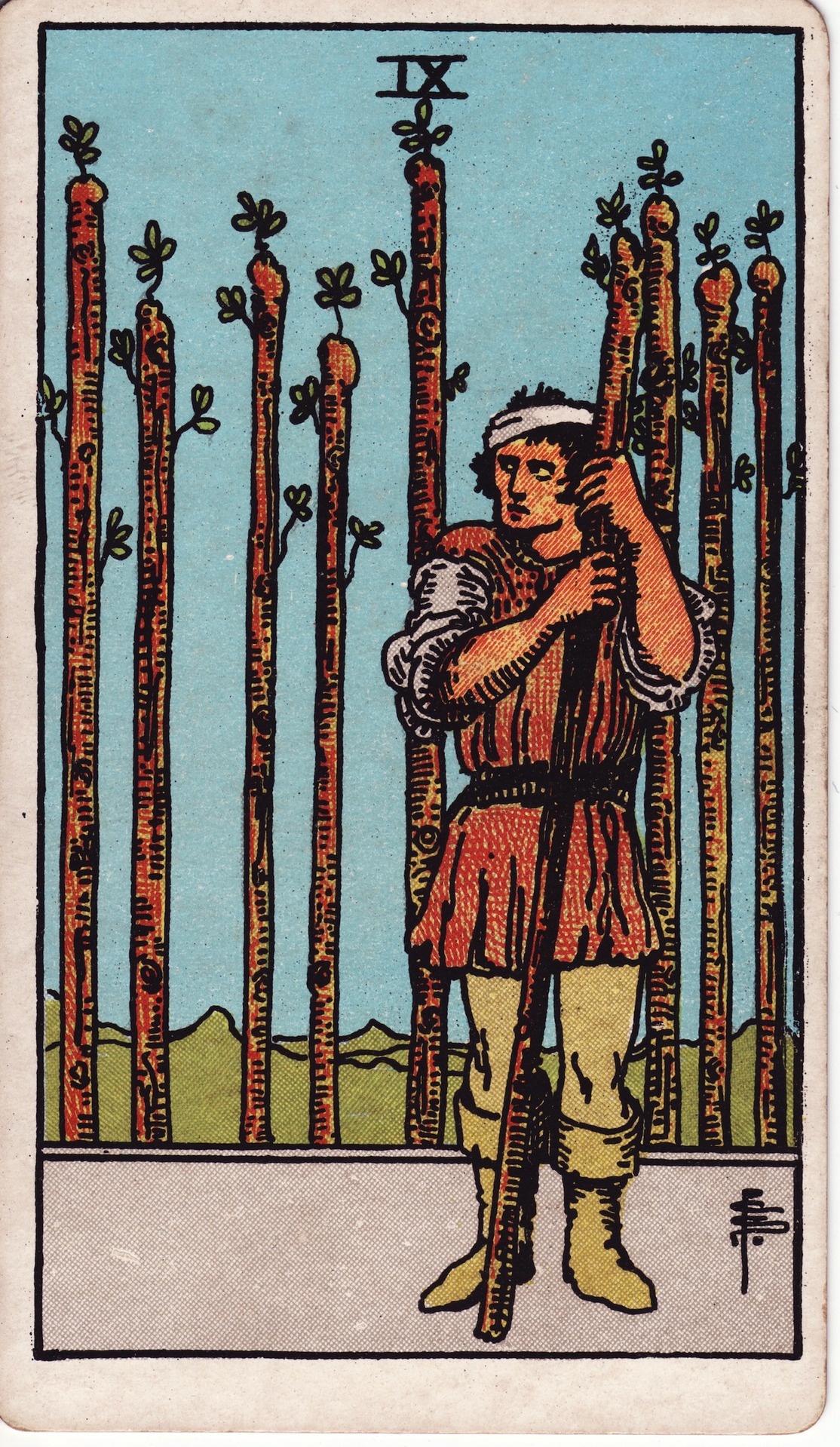
- bandaged head: past injury
Meaning
- hypervigilance, anxiety [1]
- great strength, power, recovery from sickness [2]
Wen, Benebell. Holistic Tarot: An Integrative Approach to Using Tarot for Personal Growth.
Like the fellow depicted in the card, the Seeker refuses to ask others for help and instead is left alone to defend his or her territory, and thus is stuck in that position, unable to go elsewhere. As a result, the Seeker is in a defensive mode, alone, protecting what the Seeker has rather than exploring the beyond to gain more. There is also the suggestion of a passive stance, rather than active. The character in the card seems to be waiting for something to happen. He is not an adventurer like the character in the Two of Wands who is looking outward and beyond, or marching in victory as in the Six of Wands. This is someone who just wants to defend what is rightfully his. He is not defiant, fearless, or resistant like the character in the Seven of Wands; the man here in the Nine of Wands is a bit more resigned than the other characters, acquiescing to his circumstances, though certainly not willing to give anything up either. The Nine of Wands depicts a character in a conservative position, one resistant to change, and as a result not able to achieve progress or expansion. It is worth noting that the Seeker’s protective fortress is not quite as impenetrable as the Seeker believes. Note how far apart each of the wands is set. The Seeker might be standing guard in front of the greatest vulnerability in that fortress, but there are other vulnerable areas he is not able to guard.
Reversed
The Seeker feels like he or she is battling against the world to defend what belongs to him or her, and is exhausted from that fight. There is a sense of one’s energy being depleted from battle. The Seeker feels at the brink of giving up. The Seeker is losing energy and losing his or her inner fire. The card indicates the result of what happens if a Seeker has not heeded the warning of the card upright: the Seeker is now exhausted from the fighting. The Seeker must find another way to reconcile things. While the Nine of Wands upright is about a Seeker who won’t acknowledge that inner exhaustion, the Nine of Wands in reverse indicates a Seeker who has collapsed from that exhaustion. The Nine of Wands in reverse also has a message for the Seeker: instead of standing on guard and being defensive of what the Seeker has attained in the past, the Seeker must let it go and progress forward, explore into the beyond, and learn to be more actively engaged; to be on the offensive in one sense, and acquire rather than merely protect.
Graham, Sasha. Llewellyn’s Complete Book of the Rider-Waite-Smith Tarot: A Journey Through the History, Meaning, and Use of the World’s Most Famous Deck.
Pamela adapted the image from the Book T’s description of “recovery from sickness,” as seen with the bandage on the fellow’s head. She even takes a cue for his facial expression: “Victory, preceded by apprehension and fear.” Depending on the surrounding cards, the Nine of Wands may display an unwillingness to trust others.
Pollack, Rachel. Seventy-Eight Degrees of Wisdom: A Book of Tarot.
We should not assume the card always advises us to give up fighting. To abandon defensiveness means taking a great risk, for what happens if the problems we have kept at bay for so long rush up at us? Context is everything and sometimes the context demands those powerful shoulders and sharp eyes. And yet, observe how much energy the person uses up simply keeping himself tense and ready for battle. In specific readings the true implications of this card can only become clear through seeing it combine with other cards.
References
- me
- Wang, Robert. The Qabalistic Tarot: A Textbook of Mystical Philosophy.