
And the earth no more is barren: from the seed
A harvest springs, and the whole land is filled with plenty.
–Arthur Waite, Collected Poems
Meaning
Graham, Sasha. Llewellyn’s Complete Book of the Rider-Waite-Smith Tarot: A Journey Through the History, Meaning, and Use of the World’s Most Famous Deck.
General
The Knight of Pentacles is the expansive quality and heavy energy of earth. The Knight of Pentacles is a slow landslide of momentum gathering toward inevitable manifestation. He is the stability of the ground beneath your feet. He brings about needed and lasting change. He is slow, steady, and thoughtful. The Knight of Pentacles listens for things in unexpected places. He senses what people and places need. Physicality is important to this sensual knight who is comfortable in his skin and bones.
In You
The Knight of Pentacles is activated when you act with care. You examine all options before proceeding. He is activated when you attend to worthy work. Worthy work makes your heart sing and your soul happy. It leaves its mark in the world. It could be a garden, a house, a foundation, or a school. He is a natural introvert who gains inspiration from the natural world. You’ll activate him during moments when you draw a hot cup of tea close and stare out your window while figuring out a problem or curl up in a hammock under your favorite backyard tree.
In Others
The Knight of Pentacles reflects a slow and deliberate romantic suitor. The pentacle in his hand reflects a gift similar to the Ace of Pentacles, given to you by someone you admire and respect. He is the slow and careful financial planner. He is the farmer that feels the land to determine what he will plant. He is the medical intuitive or talented masseuse who intuitively knows where to move his hands and where to find the pain. He heals.
Symbolic
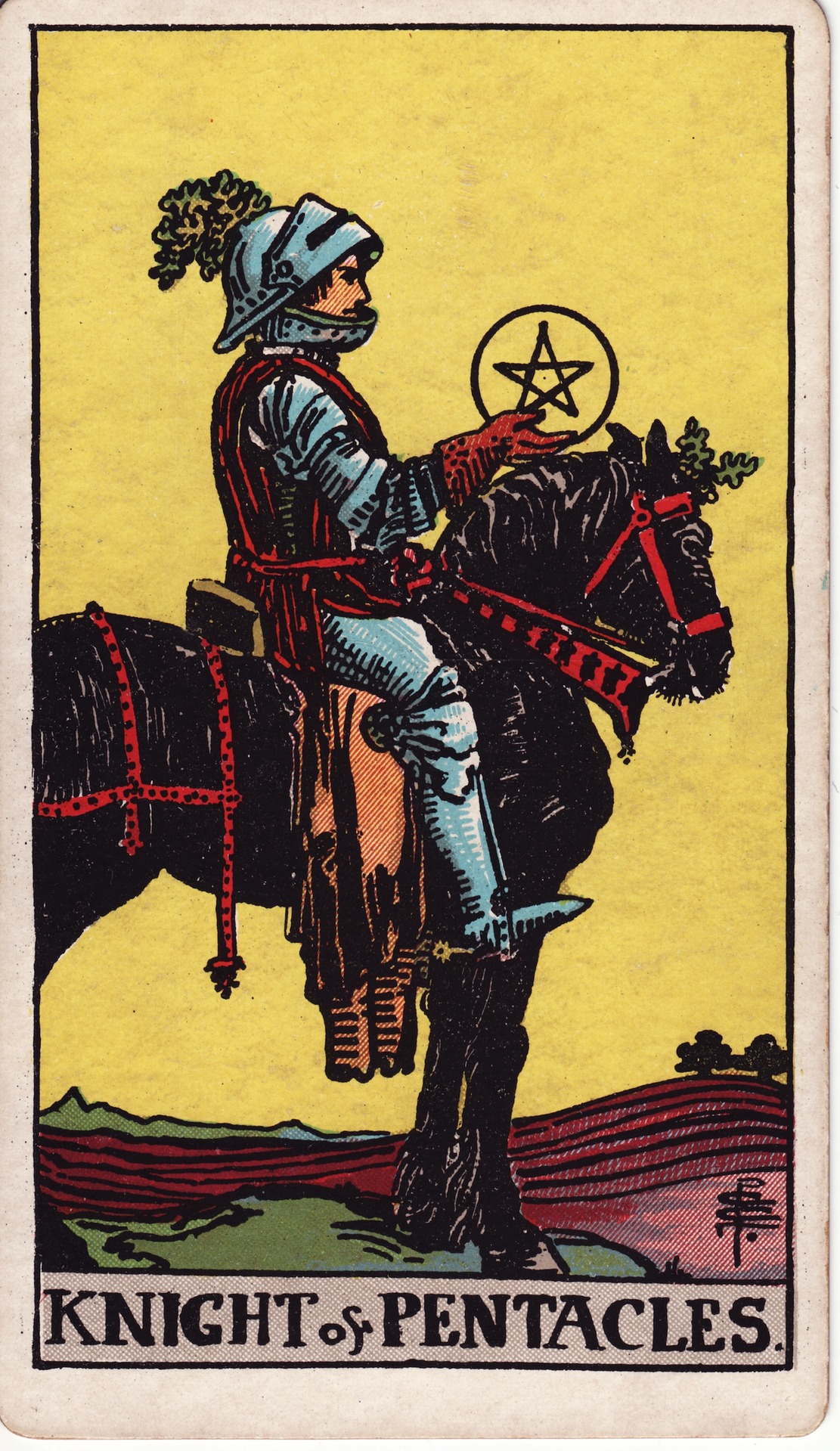
The expansive plowed field behind the Knight of Pentacles reflects the secret of the card. It is the largest planting field in the entire deck and what the knight chooses to plant shall grow to fruition. His brilliant green plume which is a symbol of growth and manifestation reminds us of his generative properties. His nurturing energy brings all things to fruition. Look to the horse’s gate on any Knight card to determine the quality and pace of action. His horse matches his master’s motion as a slow and steady animal of tremendous strength. The horse, a Clydesdale—who is traditionally used for farming, logging, and carriage pulling—reflects power and steadiness. The horse reflects the energy of the situation at hand is slow moving. The knight’s armor is heavy and protective expressing the knight’s experience in battle. Waite points out “He exhibits the symbol, but does not look therein.” Readers often examine the card and believe he is gazing into the Pentacle. It is the difference between looking at an object or focusing on the object’s potential result. According to Waite, the Knight is most concerned with results he can see, feel and touch.
Wen, Benebell. Holistic Tarot: An Integrative Approach to Using Tarot for Personal Growth.
The Knight of Pentacles is a methodical, rational man. He is trustworthy, reliable, but perhaps not very imaginative. He lives a life of conventionalism. He may have a heavy, dull, or materialistic outlook. However, he is kind and gentle and his soul is fundamentally good. He is someone whom others can count on to be financially stable. He will always take care of his loved ones. In a reading for a young female Seeker asking about love, could indicate the appearance of a young man with the foregoing qualities. Figuratively, could indicate impending action or active progress in the areas of finances, wealth, or property; however, while the other Knights suggest swift action, the action of the Knight of Pentacles is slow and steady, but stable and assured. Of the four knights, the Knight of Pentacles is the one to count on, though the Knight of Pentacles is also the one most likely to be perceived as boring or plain vanilla. The Knight of Pentacles prefers the straight and narrow path. He would rather be safe than sorry. In prosperous times, others will complain that the Knight of Pentacles is prosaic, conservative, or overly cautious; yet in tougher times, those same individuals will rush to rely on the resourcefulness of the Knight of Pentacles. In bad times, he is the one that can be counted on. Earth-dominant, the Knight of Pentacles is resourceful, utilitarian, and has more common sense than the courts of the other three suits. Could signify Capricorn, Taurus, or Virgo.
Note that two knights appearing in a tarot reading could indicate head-to-head conflict with another individual of equal rank as the Seeker. Three knights in a reading indicate fraternity or brotherhood, or a sudden change, swift action that will take the Seeker by surprise. Four knights could suggest war, combat, or matters relating to the military.
Reversed Meaning
Money affairs are at a standstill. The Knight of Pentacles in reverse could indicate timidity. Could also indicate a young man in the Seeker’s life who embodies the qualities of the Knight of Pentacles, but who has a negative impact or influence on the Seeker’s current situation. The Knight of Pentacles in reverse indicates inertia in financial matters.
Pollack, Rachel. Seventy-Eight Degrees of Wisdom: A Book of Tarot.
The Knight’s responsibility for action brings out the suit’s practical qualities. At the same time, denying the Knight’s natural penchant for adventure tends to distort and narrow his attitude to life. He is responsible, hardworking, uncomplaining. In his best sense he is deeply rooted to the outer world and to simplicity, a quality suggested by the way his horse stands firmly on the ground, with its rider sitting upright.
Though he also holds a pentacle he does not look at it, but instead stares over it. The symbolism suggests that he has lost sight of the source and meaning of his strength in life. In dedicating himself to purely practical matters, he has cut himself off from the deeper things in Earth.
Reversed
Sometimes the Knight reversed can mean an awakening of those other awarenesses. More often it shows a failure - or exaggeration - of the Knight’s more obvious virtues. His steadiness slows down to the point of inertia, his plodding responsibility gives way to idleness. A mild personality, taken just a little too far, becomes weak and depressed, especially if his placidity has covered a repressed desire for either adventure or greater advancement.
The Knight of Pentacles reversed can sometimes indicate a crisis. If a person has dedicated her or his life to a job or some similar outer responsibility, and that meaning is taken away - say through dismissal or retirement - then discouragement and depression can overcome him or her. Another example would be a woman who has dedicated her life to her children and now finds that they have grown up and away from her.
Though such extreme meanings of course occur rarely in actual readings, they remain implied in the Knight’s basic paradox: deeply grounded in, yet unaware of, the magic beneath him, he identifies himself with his functions. He needs to discover the real source of his strength, within himself and in life.
Notes
pulled after working my ass off with midterms and really the semester that’s drawing to a close. but the finish line is full of quizzes and practicals and final exams. midterms went well though. also pulled after being praised covering for a project I’ve been working on with others. I’ve been catching things others are missing.