
Eight of Cups
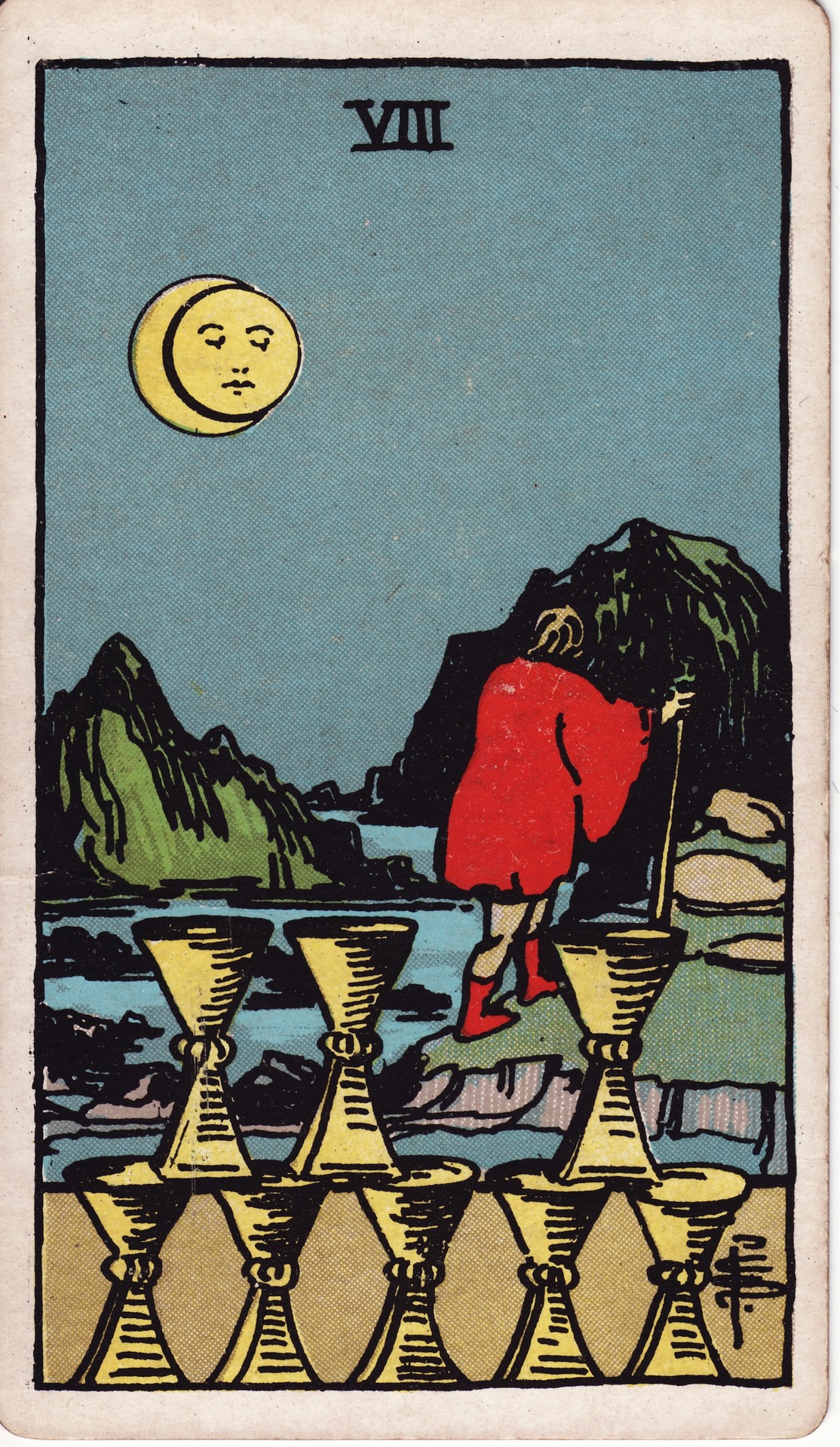
AKA Lord of Abandoned Success
Now the mild moon wax and dwindle,
Voice of winds keep calling,
While the long paths wind before me,
Falling, rising, falling.
– Arthur Waite, Collected Poems
Iconography
- waning crescent moon: release, banishment, period of deep reflection [1]
- full moon + red cloak + red boots: power, strength, transformation
- time for change, period of solitude [1]
- rocky water: disturbances in consciousness [1]
Wen, Benebell. Holistic Tarot: An Integrative Approach to Using Tarot for Personal Growth.
There has been an abandonment of past fruits. The Eight of Cups is about a soul-searching journey; ascending to higher emotional ground. The Seeker is leaving behind something he or she spent much effort and care to nurture or develop. There was disappointment in a past undertaking and thus the Seeker has abandoned his or her previous work. Note how carefully stacked the goblets are. However, the Seeker is leaving it behind on his or her own terms, at will. '
Reversed
The Eight of Cups in reverse can indicate a weary traveler who has seen the world and gone on many journeys, but is now yearning for a place to call home. In reverse, the card suggests that such a Seeker has not yet found his or her home and is now searching for what is “home.” Compare: While the Five of Cups has a latent message of returning home to make peace of what is there and needing that peace before the Seeker can progress forward, here the Eight of Cups in reverse is about a Seeker actively in search of where “home” is for him or her. If the Five of Cups is about returning home, the Eight of Cups in reverse is about finding home.
Graham, Sasha. Llewellyn’s Complete Book of the Rider-Waite-Smith Tarot: A Journey Through the History, Meaning, and Use of the World’s Most Famous Deck.
Rumi tells us, “Don’t grieve, anything you lose comes round in another form.” It is brave to walk away from a situation, person, or thing that you value and be secure in the knowledge that something similar or better will come into your life. When we are brave and test this principle, we find it to be true. We find love again. Happiness comes back around. We leave what is comfortable, secure in the knowledge we can do better, strive harder, and create something extraordinary. Our faith and hard work are rewarded. The Eight of Cups implores us to release bonds of fear and desperation to forge new ground.
The card’s figure connects to the Hermit card, reflecting the Hermit at the beginning of his journey up the mountain. Walking stick in hand, the Hermit moves toward a lofty summit, away from what has been gained. It is the essence of pilgrimage, the sacred journey of religious devotion. He moves toward spiritual heights, away from worldly goods. It is the “high road” and “the road less traveled” and all that those phrases imply.
Waite reminds us the man “is deserting the Cups of his felicity, enterprise, undertaking or previous concern.” What was once important has lost its luster. We focus on something new. Waite says that “a matter which has been thought to be important is really of slight consequence.” The transitory nature of life reveals this lesson repeatedly. When what was important, even immediate, fades away, we are confronted with new challenges and opportunities. The lessons we carry bear import and move us higher than we ever imagined.
Pollack, Rachel. Seventy-Eight Degrees of Wisdom: A Book of Tarot.
Reversed
Sometimes the upside down Eight indicates the simple negation of the card’s basic image - a refusal to leave some situation, a determination to hang on even when we know deep inside that we have taken all we can from it. Such a description characterizes many relationships.
Usually, however, the card reversed maintains its quality of awareness and correct response. It symbolizes that the time to leave has not come, that the situation will continue to give joy and meaning.
One final possibility: timidity, leaving a situation because a person lacks the courage to pursue it and take everything she or he can get from it. Many people make this a pattern in their lives; they become involved in relationships, work, projects, etc., and then run away, either when difficulties arise, or when the time comes for genuine commitment.
References
- Wen, Benebell. Holistic Tarot: An Integrative Approach to Using Tarot for Personal Growth.